Best Smoke Days in Seattle, WA
Seattle, Washington sits in the Pacific barbecue region. Seattle’s pit scene runs alder-smoked salmon alongside a growing brisket-and-rib tradition: Pacific Northwest woods and the marine climate’s mild summers favor longer, cooler cooks. This page scores the next seven days for low-and-slow cooks in the Seattle metro, weighing rain probability, sustained wind and gusts, daytime temperature, and the wet-bulb humidity that drives the stall. It then weights the result for your cut and cooker, so you can pick the day with the best odds of a clean cook.
7-day forecast for Seattle
Planning a weekend smoke in Seattle
Seattle’s smoke calendar is shaped by the wet season and the dry one. The reliable window is summer, roughly July through September, when the Pacific Northwest finally dries out and delivers mild, rain-free weekends that are some of the most pleasant cooking weather anywhere. The rest of the year is the famous damp: cool, gray, and persistently wet from October into June, with rain more often a drizzle than a downpour. It rarely gets cold enough to freeze out a cook, but the moisture is constant.
The marine climate’s mild temperatures favor longer, cooler cooks, and the low summer humidity keeps stalls manageable. The variable to plan around is rain rather than heat or wind: an insulated kamado or pellet cooker shrugs off a drizzle and holds its cook through the damp shoulder seasons, while an open offset is happiest in the dry July-to-September stretch. Seattle’s pits run alder-smoked salmon alongside a growing brisket scene, and the regional woods suit the mild climate. Pick a dry day off the score, keep the cooker under cover if you can, and the summer window will reward you.
Seattle climate normals by month
Typical conditions for each month, scored 0-100 for a packer brisket on an offset, the most weather-sensitive low-and-slow cook. Temperature and rain days are NOAA 1991-2020 climate normals; wind and humidity are 2015-2024 reanalysis averages.
| Month | Avg High | Avg Low | Avg Wind | Humidity | Rain Days | Smoke Score |
|---|---|---|---|---|---|---|
| January | 48.6°F | 36.8°F | 7.3 mph | 84% | 12.1 | 62 |
| February | 50.7°F | 36.8°F | 7.4 mph | 82% | 9.0 | 66 |
| March | 54.8°F | 39.4°F | 7.3 mph | 80% | 10.5 | 67 |
| April | 59.8°F | 43.6°F | 7.3 mph | 77% | 8.0 | 72 |
| May | 66.5°F | 49.3°F | 6.2 mph | 74% | 5.6 | 76 |
| June | 71.2°F | 54.0°F | 6.3 mph | 70% | 3.6 | 80 |
| July | 77.3°F | 57.5°F | 5.9 mph | 66% | 1.3 | 84 |
| August | 77.4°F | 58.1°F | 6.0 mph | 68% | 1.8 | 83 |
| September | 71.7°F | 53.9°F | 6.3 mph | 76% | 3.8 | 79 |
| October | 61.0°F | 46.4°F | 6.9 mph | 82% | 7.8 | 72 |
| November | 53.0°F | 39.9°F | 7.7 mph | 83% | 11.3 | 65 |
| December | 47.8°F | 36.2°F | 7.6 mph | 84% | 11.4 | 63 |
Historically, the best months to smoke in Seattle are July, August, and June. November is the windiest month (avg 7.7 mph): the one to plan around.
Seattle’s smoke season, month by month
Seattle’s spring (March–May) is strong, scoring 72 on 60°F highs, 44°F lows and wind near 6.9 mph as the stall digs in and holds. In summer (June–August), Seattle rates 82/100, a strong window with 75°F days, 57°F nights and 6.1 mph of wind as the plateau runs long and flat. Seattle in fall (September–November) grades strong at 72/100: highs near 62°F, lows near 47°F, wind about 7.0 mph as a stubborn stall settles over the cook. Through winter (December–February), Seattle runs workable: a 64 score off 49°F highs, 37°F lows, and 7.4-mph wind as rain threatens the cook.
July is the prime month to smoke in Seattle at 84/100; January is the hardest at 62 where wet days scrub Saturdays.
Count it up and Seattle lands 7 of 12 months at Good or better, best in July at 84, though none crack the 85 Ideal mark.
With a 82 summer in Seattle, the stall sticks; paper-wrap the long cuts early and a kamado pays back the fuel.
Barbecue heritage
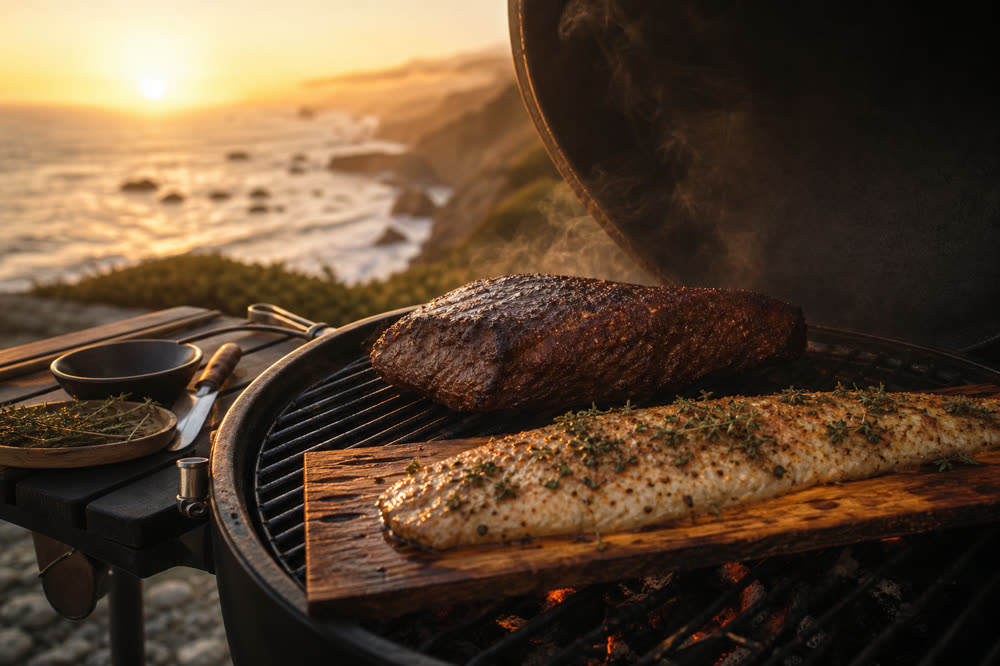
Seattle’s most authentic smoked-meat tradition isn’t Southern at all: it’s Pacific Northwest smoked salmon, alder-wood cured and slow-smoked, a practice that predates any Southern-style pit by generations. That said, the past two decades have produced a serious modern BBQ scene, with Texas-style brisket and Carolina whole-hog finding committed practitioners. The PNW’s premium wood supply (alder, cherry, apple) gives Seattle pitmasters excellent raw materials alongside the traditional Southern hardwoods.
Seattle climate
The Pacific climate is mild and marine-influenced. Summer along the coast rarely climbs above 80 °F, dew points stay moderate, and the only persistent variable is afternoon wind off the water. Inland from the coast (eastern Oregon, central California), the picture shifts toward the dry, hot pattern of the Mountain region. Winters are wet, especially north of San Francisco, but rarely cold enough to shut down a well-insulated cooker. The cook calendar is the longest of any region; weekend windows survive year-round.
In Seattle, the normals bear this out: November is the windiest month at 7.7 mph, while July scores highest for low-and-slow at 84 of 100.
Cooker fit for Seattle
Pacific cooks have the easiest climate in the country and the widest cooker latitude. Offsets, pellets, kamados, kettles and electrics all work well most of the year. The variable to plan around is coastal wind in the afternoons; an inland yard a few miles back from the water sees less of it.
Seattle grades Good or better in 7 of 12 months; on the windiest weekends, plan for gusts near 11 mph and let an insulated cooker carry the long cuts.
Pick a day with a strong score, light the fire, and stop guessing whether Saturday in Seattle will hold. The form lets you swap cut and cooker without leaving the page, and your selection persists across visits via local storage. ZIP defaults to 98101 for the Seattle metro; change it any time to score a different yard.
Frequently asked questions
What makes a day a good smoke day in Seattle?
Which cooker works best in Seattle?
How accurate is the Seattle forecast?
Forecasts model regional weather, not your microclimate. Trees, structures, and elevation can shift wind and temperature noticeably from the airport-grade source we pull. Always step outside before lighting the fire.