
Pork Shoulder Smoking Calculator
Enter your pork butt details and serve time. The calculator works backward to give you a precise cook timeline with stall prediction.
Style
The bone-wiggle test is the best doneness indicator.
The calculator works backward from this time.
Cook timeline
Have a current temp reading?
Enter it to recalculate remaining time based on where the pork is right now.
Step-by-Step Timeline
This estimate assumes steady pit temperature and average meat geometry. It does not account for collagen breakdown variability, fat content differences, meat grade, or smoker heat distribution. Always cook to internal temperature, not to the clock. Build in a 1–2 hour buffer and use a faux cambro hold if you finish early.
How long to smoke a pork shoulder
Pork shoulder, sold as either "Boston butt" (the upper portion) or "picnic shoulder" (the lower portion), is one of the most forgiving cuts for the smoker. Unlike brisket, which punishes an extra degree or two of overcooking, pork shoulder has so much collagen and intramuscular fat that it tolerates a wide temperature window and rewards the patient cook who lets the process run its full course.
The standard rule of thumb is about 1.5 hours per pound at 225°F for a mid-size butt, but the rate is not flat: smaller butts run more hours per pound and bigger butts fewer, because thickness grows slower than weight. An 8-pound boneless Boston butt will typically finish in about 12 hours. A 10-pound bone-in shoulder can run about 15 hours. These estimates assume a consistent cooker temperature, a preheated smoker, and a foil or butcher paper wrap around the stall. Add 15 to 20 minutes any time you open the lid for a significant period. Pork shoulder is forgiving, but wind and cold still stretch the cook: the smoke-weather forecast flags days that will hold a steady pit temperature.
The safest approach is always to work backward from a serve time rather than forward from a start time. Add cook time plus rest time, count backward from when you want to eat, subtract 30 minutes for preheat, and set your alarm. If the cook runs short, the faux Cambro hold makes a 3-hour buffer essentially free. If pork shoulder is only one part of the meal, the Cook Time Coordinator helps line it up with your other meats.
Bone-in vs. boneless
Bone-in pork shoulder is the classic choice for a reason. The bone, a dense femur running through the center of the butt, acts as a natural heat conductor, drawing warmth into the thickest part of the muscle and promoting even cooking. It also contributes collagen that dissolves into the surrounding meat over a long cook, adding body and richness to the finished pulled pork.
On the downside, bone-in shoulders take roughly 10 to 15% longer than boneless of the same stated weight, because that weight includes bone that contributes no yield. A 10-pound bone-in butt typically yields about 6 pounds of pulled pork once cooked and cleaned. A 10-pound boneless shoulder yields closer to 7 pounds. For guest-count planning, the Meat Per Person Calculator converts that finished pork into realistic servings.
The classic bone-in doneness test: grip the exposed bone end with a paper towel and wiggle. When the bone rotates freely with almost no resistance, the pork is ready to pull. It is a more intuitive test than chasing a temperature reading and works regardless of how the stall varied that day.
The stall on pork butt
Every pork shoulder smoker eventually encounters the stall: a plateau in internal temperature that typically sets in around 150 to 165°F and can last anywhere from 2 to 5 hours. First-time pitmasters often assume something has gone wrong. Nothing has. The stall is a natural consequence of evaporative cooling: as the interior temperature of the meat rises, moisture migrates toward the surface. That surface moisture evaporates, and the cooling effect of evaporation perfectly counteracts the heat coming from the smoker, holding the internal temperature flat.
The stall eventually breaks on its own when the surface moisture is exhausted and the cooler can no longer keep up with the smoker. But you can dramatically shorten the stall by wrapping the shoulder in foil or butcher paper once you see the plateau begin, typically around 155 to 160°F. Wrapping seals the surface so moisture can no longer evaporate off it, eliminating the evaporative cooling effect and allowing the temperature to climb again within 30 to 60 minutes.
- Foil wrap: fastest through the stall, produces the most tender meat, softer bark
- Butcher paper: lets some moisture escape, preserves more bark texture, slower than foil
- No wrap (naked): maximum bark development, longest cook time, requires patience
Bark starts with the rub, not the wrap: scale the rub for this pork shoulder so coverage matches the weight you entered above.
Pulled vs. sliced pork
The style you choose determines your pull temperature. For pulled pork, the classic competition standard where the meat shreds in long strands with two forks or a pair of bear claws, you need to reach 203 to 207°F internal. At that temperature, the collagen has fully converted to gelatin, the connective tissue has dissolved, and the muscle fibers separate easily.
For sliced pork butt, pull at 185°F. At this temperature the pork is fully cooked, juicy, and firm enough to hold together for the knife. You will get clean slices that still show the money muscle: the cylindrical section along the front of the butt that is valued for its fine grain and tenderness. Many competition teams cook to 185°F to present the money muscle, then rely on the tenderness of the surrounding shoulder to pull cleanly as they work through the cut.
Regardless of target temperature, the probe test is your final confirmation: insert a thermometer probe anywhere in the thickest part of the meat. When it glides in and out with zero resistance, exactly like inserting a toothpick into room-temperature butter, the pork is ready.
Feeding a crowd rather than a family dinner? Calculate pulled pork for your guest count before you buy the shoulder — serving math, not cook time, is what usually runs short.
Resting and pulling
Resting is not optional. A properly rested pork shoulder is noticeably juicier than one pulled immediately off the smoker, because the muscle fibers, contracted by heat during cooking, relax during the rest and reabsorb the juices that were driven toward the center. A minimum rest of 60 minutes is mandatory. Longer is better.
The faux Cambro method extends the hold dramatically. Double-wrap the finished shoulder tightly in heavy-duty foil. Line a dry cooler with old bath towels. Place the wrapped shoulder inside, fold the towels over the top, and close the lid. A properly set-up faux Cambro will keep a pork shoulder safely above 140°F (the USDA safe holding temperature) for 4 to 6 hours, which also means you can finish the cook 4 hours before serve time without any quality loss.
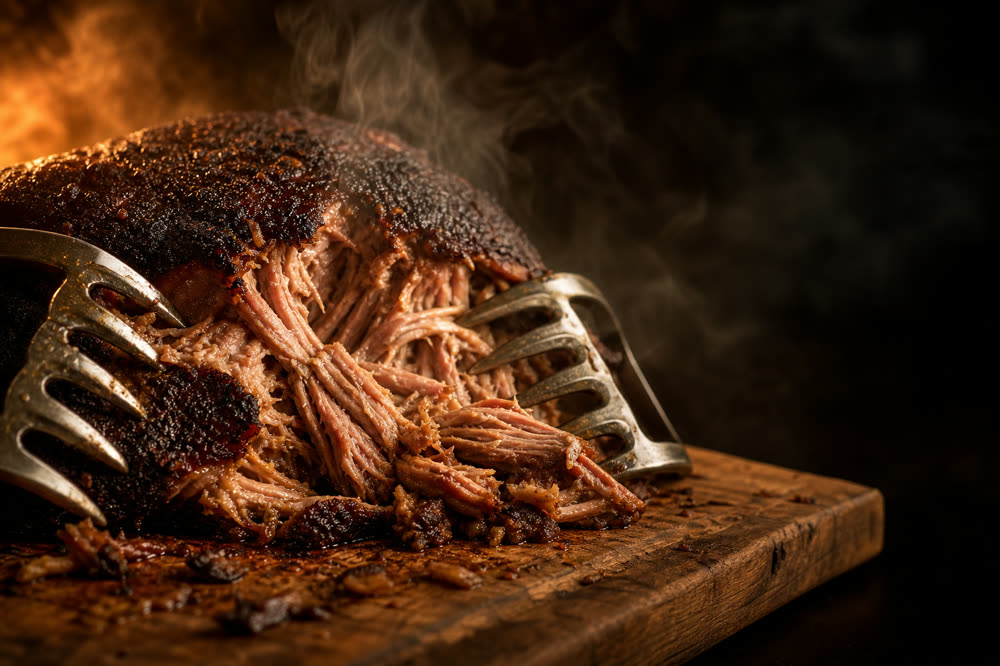
When pulling, wear heat-resistant gloves and pull directly with your hands for the best feel, or use a pair of bear claws for speed. Pull into fist-sized chunks first, then shred. Save every drop of liquid that collects in the foil: it is concentrated pork jus that you pour back over the finished pulled pork to keep it moist during service.
Pork shoulder smoke time reference
Estimated cook times for pulled pork (203°F target) with foil wrap. Boneless shoulder, consistent smoker temperature. Times scale sub-linearly with weight: a lighter butt is not proportionally thinner, so it does not finish proportionally faster. Bone-in adds about 10%.
| Smoker Temp | 4 lbs | 6 lbs | 8 lbs | 10 lbs | 12 lbs |
|---|---|---|---|---|---|
| 225°F | 7.6 hrs | 9.9 hrs | 12.0 hrs | 13.9 hrs | 15.7 hrs |
| 250°F | 5.3 hrs | 7.0 hrs | 8.4 hrs | 9.8 hrs | 11.0 hrs |
| 275°F | 4.2 hrs | 5.5 hrs | 6.7 hrs | 7.7 hrs | 8.7 hrs |
| 300°F | 3.5 hrs | 4.6 hrs | 5.6 hrs | 6.5 hrs | 7.3 hrs |
Worked examples: pork shoulder cooks
Each example quotes the calculator's own output at its defaults — pellet-grill humidity, meat from the fridge, pulled-pork target of 203°F, foil wrap at the stall unless noted. Add the 60-minute minimum rest to every total.
7 lb boneless at 225°F
The calculator returns 10h 59m — call it 11 hours. For a 6 PM dinner with the minimum rest, the meat goes on at 6 AM and the smoker lights half an hour before that.
Bone-in vs. boneless: 8 lb at 250°F
Boneless: 8h 27m. The same weight bone-in adds about 10% for the bone's mass and slower conduction path: 9h 18m. The trade is worth it for many cooks — the bone-wiggle doneness test and the extra collagen come free.
10 lb boneless at 275°F (hot and fast)
7h 44m — a double-digit shoulder finished in a single daylight cook. Hot-and-fast sacrifices a little bark tenderness for schedule, and the foil wrap matters more here because the stall would otherwise eat the time you saved.
12 lb bone-in at 225°F
17h 15m — a true overnight cook. Note that this is less than flat per-pound math predicts: 12 lb × 1.5 h/lb plus the 10% bone-in premium would say nearly 20 hours. Big butts gain thickness slower than weight, so the hours-per-pound rate falls as the cut grows.
What skipping the wrap costs
An 8-lb boneless butt at 250°F runs 8h 27m foiled but 12h 52m naked — the full evaporative stall costs about 4½ hours at pellet-grill humidity. Maximum bark has a price; pay it deliberately.
Frequently asked questions
How long to smoke a pork shoulder?
What temp to pull pork butt?
Bone-in or boneless pork butt for smoking?
Why is my pork butt stalling at 165°F?
How long to rest pork shoulder?
Method, assumptions & sources
How this calculator gets its numbers
Formula. Total time = baseline diffusion cook + stall dwell. The baseline is a heat-diffusion phase, t = Km × L² × ln((Tpit − Tstart) / (Tpit − Tpull)), with Km calibrated to forum and competition cook data. The stall is an additive dwell at the evaporative plateau: it grows with thickness squared and with the pit's wet-bulb temperature, which comes from a cooker humidity model (an offset runs ~4% RH, a kamado ~25%), so humid pits stall longer. Wrapping cuts the remaining dwell: foil removes it, butcher paper leaves ~45%, a foil boat ~70%. Bone-in adds 10% to the result.
Assumptions. Meat starts at 38°F. Pull targets: 203°F pulled (60-minute minimum rest), 185°F sliced (45 minutes); the wrap decision point defaults to 150°F internal. Optional inputs (water pan, spritzing, injection, fat cap, wind, ambient weather, altitude) adjust the humidity and thickness terms of the model rather than applying flat fudge factors.
Sources. The stall physics (Stull 2011 wet-bulb formula; Greg Blonder's stall research; AmazingRibs on humidity and wrapping) are cited in full on our methodology page, and we collect reader-submitted cook logs to check the model against real cooks — real stall data is what will tighten these predictions. Doneness targets are quality temperatures well above the USDA pork minimum of 145°F (safe temperature chart).
Reviewed by James "Monty" Montgomery. Last reviewed: August 6, 2026. Estimates, not guarantees — pull when the bone wiggles free and the probe slides clean, not when the clock says so. How we source and correct numbers: editorial policy.