Brisket Yield Calculator
Enter packer weight and USDA grade to get flat weight, point weight, trimmed raw weight, cooked yield at 195°F and 203°F, estimated servings, and how many packers to buy for your party.
Quick answer: a whole packer brisket keeps 48–62% of its raw weight after trimming and cooking, under the selected planning assumptions, not a guarantee from grade or temperature. A typical Choice packer yields about 58% at a 195°F sliced pull (53% at 203°F pulled) — so a 15 lb packer gives you roughly 8.7 lbs of sliceable brisket, about 23 six-ounce servings. Enter your exact weight and grade below.
Packer Details
Packer Weight Breakdown
Understanding brisket yield
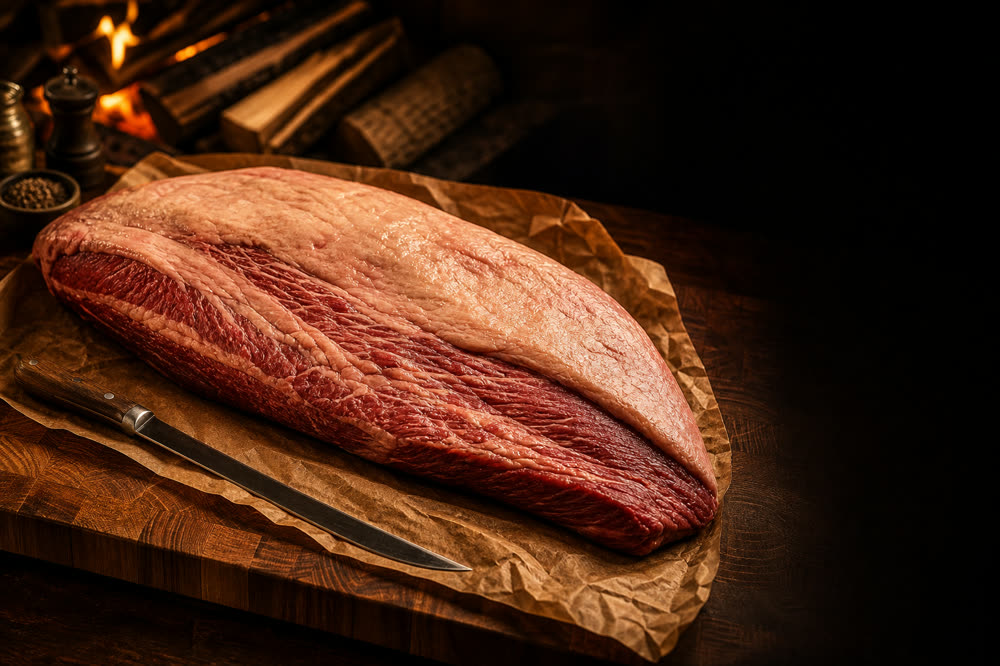
A packer brisket is the whole, untrimmed brisket as it comes from the processing facility. It consists of two muscles, the flat and the point, surrounded by a thick fat cap and separated internally by a layer of hard fat. When you buy a 15 lb packer brisket, you are not buying 15 lbs of edible meat. You are buying roughly 13 lbs of raw beef after trimming, and somewhere between 7 and 9 lbs of cooked, sliceable, ready-to-eat brisket. The rest is water, fat, and connective tissue that renders, evaporates, or gets trimmed away before the meat ever hits the smoker.
Yield decides how much raw brisket you need to buy. The calculator uses explicit planning factors, not validated grade-specific predictions. We have not published controlled cook data supporting these grade differences. Yield is also weather-sensitive: wind and cold draw extra moisture during the cook, so the smoke-weather forecast helps you pick a calmer day for a more predictable finish.
USDA grade scenarios and their limits
The percentages below include trimming and cooking losses from the original purchased packer weight. Do not subtract trimming twice. Unlike the general quantity calculator's prepared-meat estimate, these figures start with an untrimmed packer. No buying buffer is included; packer counts round up to whole pieces.
The three USDA beef grades you will encounter at retail and wholesale (Select, Choice, and Prime) differ primarily in marbling, the intramuscular fat streaked through the muscle fibers. Grade describes quality characteristics; it does not guarantee the exact cooked yield shown here.
- USDA Select scenario: assumes 87% retained after trimming, then 53% cooked yield from purchased weight at the lower target.
- USDA Choice scenario: assumes 88% retained after trimming and 58% cooked yield from purchased weight.
- USDA Prime scenario: assumes 90% retained after trimming and 62% cooked yield from purchased weight. These are adjustable expectations for planning, not measured grade averages.
On a 15 lb packer brisket, that difference works out to roughly 1.4 lbs more cooked meat from Prime versus Select. At 6 oz per serving, that difference is about 3.6 servings in this scenario.
The flat vs. the point
The flat is the larger, thinner, rectangular muscle that runs the length of the brisket. It makes up approximately 57 to 59% of the packer's raw weight depending on grade. The flat is leaner, more uniform in thickness, and ideal for slicing. Texas-style brisket plates are built around the flat: 1/4-inch slices cut against the grain, with a smoke ring and a tight bark.
The point (sometimes called the deckle or nose) is the smaller, thicker, heavily marbled muscle at the fat end of the packer. It makes up roughly 41 to 43% of packer weight. The point has far more intramuscular fat than the flat, which makes it exceptional for burnt ends: diced, sauced, and returned to the smoker for a caramelized bark on every surface. When the point is cooked to 203°F and shredded, it becomes pulled brisket, fatty and intensely beefy.
On a 15 lb Choice packer, you can expect roughly 8.7 lbs of raw flat and 6.3 lbs of raw point before cooking. After the cook at 195°F, those weights shrink substantially, but the point loses proportionally more because it renders more fat.
195°F vs. 203°F: does it matter?
Yes, and texture is only part of the reason. The additional time needed to bring a brisket from 195°F to 203°F results in continued fat rendering and moisture evaporation. This calculator assumes a five-percentage-point difference; temperature alone cannot predict actual yield.
At 195°F, check whether the flat probes tender; a thermometer reading alone does not establish texture. This is a planning target for sliced brisket, and the Brisket Calculator is the right tool when you need the full cook timeline to hit that target cleanly.
At 203°F, more fat has rendered out of both the flat and the point. Check whether the point pulls apart easily; the temperature does not guarantee that texture. The flat at 203°F is extremely tender but may not hold together for clean slices, depending on the individual brisket. This temperature is preferred when making burnt ends or pulled brisket, or when cooking the point separately from the flat.
The yield difference matters when planning quantities. A Choice packer yielding 58% at 195°F yields only 53% at 203°F. On a 15 lb packer, that is 8.7 lbs versus 8.0 lbs, three-quarters of a pound less. When you are buying for a crowd, factor the target temperature into your quantity calculation.
How much brisket to buy for a party
The quick math at 6 oz per serving: divide total guests by the number of servings per packer. A 15 lb Choice packer yields roughly 8.7 lbs of cooked brisket at 195°F. At 6 oz per person, that is about 23 servings. For 50 guests, you need 3 packers. For 100 guests, 5 packers. If you are comparing brisket against pork, ribs, or mixed proteins for the same event, the Meat Per Person Calculator gives you the broader serving math — and when brisket is one part of a bigger menu with sides and multiple meats, turn the yield into a full catering plan.
Always round up. Brisket shrinkage is variable: a brisket that stalls longer, cooks at a slightly higher temperature, or has an unusually thick fat cap will yield less than the average. Planning for 10 to 15% more than you think you need protects you from running short. Leftover brisket freezes beautifully and is excellent in tacos, hash, and sandwiches the next day.
Cooked yield reference table at 195°F
Estimated cooked weight by packer weight and USDA grade. All figures in pounds.
| Packer (lbs) | Select | Choice | Prime |
|---|---|---|---|
| 10 lbs | 5.3 lbs | 5.8 lbs | 6.2 lbs |
| 12 lbs | 6.4 lbs | 7.0 lbs | 7.4 lbs |
| 14 lbs | 7.4 lbs | 8.1 lbs | 8.7 lbs |
| 16 lbs | 8.5 lbs | 9.3 lbs | 9.9 lbs |
| 18 lbs | 9.5 lbs | 10.4 lbs | 11.2 lbs |
| 20 lbs | 10.6 lbs | 11.6 lbs | 12.4 lbs |
Frequently asked questions
How much does a brisket shrink when smoked?
What is the cooked yield percentage of a brisket?
What is the difference between the flat and the point on a brisket?
Does USDA grade affect brisket yield?
How many pounds of brisket do I need per person?
Method, assumptions & sources
How this calculator gets its numbers
Yield methodology. Every output is a grade-specific factor multiplied by the raw packer weight: flat/point split, post-trim weight, and cooked yield at 195°F (sliced) and 203°F (pulled). Servings divide the cooked ounces by your serving size (4, 6, or 8 oz).
Assumptions. Grade factors used — Select: 87% after trim, 53% cooked yield at 195°F, 48% at 203°F; Choice: 88% / 58% / 53%; Prime: 90% / 62% / 57%. Flat-to-point split runs 57/43 (Select) to 59/41 (Prime). These grade-labeled scenarios are assumptions; they are not validated causal predictions. Accepted packer weight range is 5–30 lbs.
Sources. For background on how cooking losses are measured, see USDA cooking-yield research ; this source does not validate our exact grade-specific factors. We need purchased, post-trim and edible cooked weights from documented repeat cooks before claiming calibration.
Reviewed by James "Monty" Montgomery. Last reviewed: August 5, 2026. Your trim style and pit will move these numbers a few points either way — buy toward the high side for events. How we source and correct numbers: editorial policy.