How to Wrap a Brisket
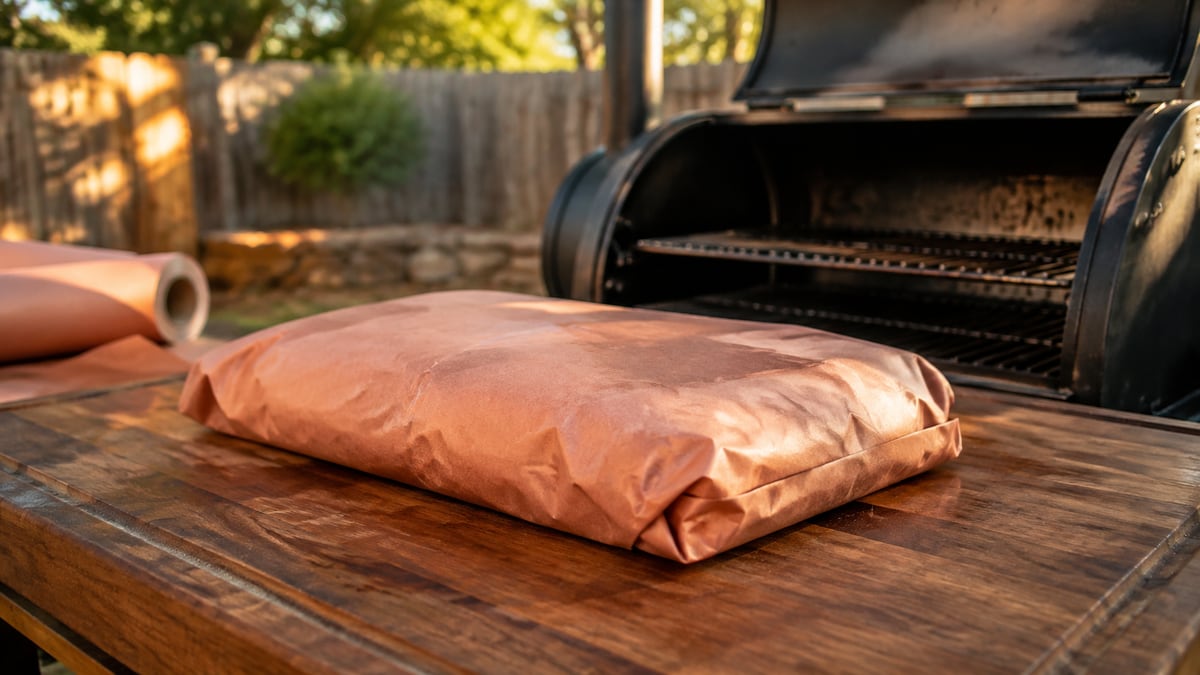
Wrap brisket once the bark is set, often around 160°F internal. Fold heavy-duty foil or unwaxed butcher paper snugly around it, tuck the seam underneath, and return it to the smoker. Choose foil for speed or paper for firmer bark.
How to wrap a brisket, step by step
- Check the bark. The surface should be dark and the rub should stay in place when lightly touched. Use bark condition, not temperature alone, to decide when to wrap.
- Prepare the wrap. Overlap two sheets of unwaxed butcher paper or heavy-duty foil to make a surface wider than the brisket, with enough length to fold around it.
- Fold it snugly. Using heat-resistant gloves, set the brisket in the center. Fold the near edge over it, tuck in both sides, then roll it away from you until the seam is underneath.
- Return it to the smoker. Reinsert your probe through the wrap into the thickest part of the flat. Keep checking as it approaches tenderness; wrapping can speed up the remaining cook.
Need a start time? Compare wrap methods in the brisket calculator. If the temperature has stopped climbing, see how to manage the stall.
Foil or butcher paper?
| Wrap | Cook time | Bark | Best for |
|---|---|---|---|
| Heavy-duty foil | Fastest through the stall | Softer from trapped steam | A tight schedule |
| Unwaxed butcher paper | Slower than foil | Firmer than foil | A balance of bark and speed |
| No wrap | Longest stall | Firmest crust | Extra time and a bark-first cook |
When to wrap
Wrap when the bark is set, not a minute before. The test is your finger: drag it across the surface, and if the rub and crust stay put instead of smearing, the bark has formed and locked on. That usually happens once the brisket has pushed into the stall, often around 160°F or so, with the outside gone a deep, even mahogany.
Timing cuts both ways. Wrap too early and you smother the bark before it ever develops, so you end up with a pot-roast texture and a pale exterior. Wait far too long and you're just burning daylight in the stall for nothing. If the stall itself is new to you, read managing the stall first, because the wrap decision and the stall are really the same moment of the cook.
Foil, paper, or nothing
All three get you to a finished brisket. Each one gives something up to gain something else.
Foil
Foil seals tight and lets nothing escape. It powers through the stall the fastest of the three and gently braises the meat in its own juices, which makes for a forgiving, tender result. The cost is the bark: trapped steam softens the crust you worked hours to build, leaving it more chewy than crisp. Reach for foil when the clock is against you, or when you're feeding a crowd that cares more about tenderness than texture. Some people call it the Texas crutch, usually with a grin.
Butcher paper
Unwaxed pink butcher paper is the middle path, and it's what most brisket cooks reach for. It blocks most of the evaporation that drives the stall, so you keep most of the speed, but it breathes just enough that the bark stays firm instead of going soft. You give up a little time against foil and gain a much better crust. If you want most of the crust with most of the speed, paper's the pick.
No wrap
Cooking the whole way through unwrapped, often called cooking naked, gives you the firmest bark and the deepest smoke flavor, because the surface never stops drying and the smoke never stops landing on bare meat. The catch is time and babysitting: a naked brisket sits in the stall the longest and wants a steadier fire, since there's no foil buffer to smooth out a swing. If bark is your religion and you've got the whole morning to give it, this is the way.
The foil boat
There's a fourth option worth knowing: the foil boat. Instead of sealing the brisket up, you set it in an open foil tray so the bottom and sides are protected while the top stays exposed to smoke and air. It splits the difference, shaving some stall time without steaming the top bark soft. It's a newer trick and worth stealing if you want most of the bark of a naked cook with a little of the speed of a wrap.
Should you add tallow?
Plenty of cooks lay a few spoonfuls of beef tallow on the paper before they wrap. It bastes the brisket as it finishes and adds a little fat back to the flat. It won't save a brisket you wrapped too early, and it's not required, but if you've got rendered tallow on hand it's an easy upgrade. Skip it your first time so you learn what your brisket does plain, then add it once you have a baseline to compare against.
What wrapping does to your timeline
A wrapped brisket finishes noticeably sooner than a bare one, sometimes by a couple of hours, so it's easy to overshoot if you stop paying attention. The brisket calculator factors in your wrap method when it works out a start time. Whatever you choose, don't shortcut the rest at the end: pull the brisket around 200°F to 205°F when it probes like soft butter, then let it sit wrapped for at least an hour. Skip the rest and you'll lose the juice you worked all day to keep.
Common mistakes
The big one is wrapping too early, before the bark has set, which trades the best part of a brisket for a little speed. Next is wrapping loose, which traps steam in pockets and softens the crust unevenly. People also forget that the wrap speeds up the climb, so they wander off and sail past their target temp. And plenty of good briskets get sliced too soon. Give it the rest it's asking for, and the slices hold together better and eat juicier.
Wrapping FAQ
When should I wrap a brisket?
Wrap when the bark is set and stays put under your finger, usually around the start of the stall near 160°F.
Is foil or butcher paper better?
Foil is fastest and softens bark more. Pink unwaxed butcher paper takes a little longer while keeping the crust firmer.
Can I cook a brisket without wrapping it?
Yes. A naked brisket develops the firmest bark, but it takes longer and needs a steadier fire.