Smoked Ham Calculator
Pick your ham and your serve time. Get the size to buy, the USDA target and a smoke and glaze schedule worked back from dinner.
Your Ham Timeline
Ham Size
Cook Timeline
The plan uses the top of the per-pound range, and the first check comes at the bottom. Planning long is the safer mistake: a ham that is ready early can wait, but dinner can't. The probe decides, not the clock.
How Much Ham Per Person
USDA FSIS sizes a ham by servings: "1/3-1/2 lb. of meat per serving of bone-in ham" and "1/4-1/3 lb. per serving of boneless ham." The calculator shows the whole range and plans on the upper end, since a holiday table rarely stops at one slice. Twelve guests need 4 to 6 lbs bone-in, or 3 to 4 lbs boneless.
Feeding a crowd with more than one meat? The meat per person calculator splits the total across cuts, and the catering calculator adds sides and cost.
Which Ham Do You Have?
The label decides the target temperature and the timetable, so start there.
- Fully cooked hams (spiral, bone-in and boneless) can be eaten cold. Smoking one is reheating it with smoke, which is what a double smoked ham is.
- Cook-before-eating hams are cured but not cooked. FSIS says hams that must be cooked "will bear cooking instructions and safe handling instructions."
- Fresh ham is raw pork leg that was never cured, so you cook it like a pork roast.
Country ham is dry cured, very salty and handled differently, so it is not in this calculator.
How Long to Smoke a Ham
At 325°F the calculator uses the FSIS ham timetable. Each row gives a range of minutes per pound, and the plan uses the top of the range so the ham is ready before dinner. The first temperature check comes at the bottom of the range. Whole or half picks the row, not the weight, and a weight outside the row's band uses that row anyway with a note to check early. Smokers land in the same place: Grill Masters Club gives "10 to 15 minutes per pound at 325F" for a spiral ham, inside the FSIS spiral range of 10 to 18.
The 250°F rows are lower and slower, and each comes from a single Smoked BBQ Source recipe rather than a tested table. Their spiral ham recipe says "The smoking time for this type of ham is 15-20 minutes per pound," for a 10 lb ham. Their glazed bone-in recipe took "about 3 hours for an 8lb ham smoking at 250°F," which the calculator plans as 22.5 minutes per pound, with a first check at 17.5.
There is no per-pound time here for 225°F. AmazingRibs smokes its double smoked ham at 225°F and says "it could take 3 to 4 hours to hit 130°F," without tying that to weight.
Minutes Per Pound by Ham
| Ham | Smoker | Weight | Minutes per lb | Source |
|---|---|---|---|---|
| Fully cooked spiral-cut ham | 250°F | 10 lb recipe | 15 to 20 | Smoked BBQ Source, one recipe |
| Fully cooked spiral-cut ham | 325°F | 7 to 9 lb | 10 to 18 | USDA FSIS |
| Fully cooked bone-in ham (double smoked) | 250°F | 8 lb recipe | 22.5 (check at 17.5) | Smoked BBQ Source, one recipe |
| Fully cooked bone-in ham (double smoked), whole | 325°F | 10 to 14 lb | 15 to 18 | USDA FSIS |
| Fully cooked bone-in ham (double smoked), half | 325°F | 5 to 7 lb | 18 to 24 | USDA FSIS |
| Fully cooked boneless ham, vacuum packed | 325°F | 6 to 12 lb | 10 to 15 | USDA FSIS |
| Fully cooked boneless ham, canned | 325°F | 3 to 10 lb | 15 to 20 | USDA FSIS |
| Cook-before-eating ham, bone-in, whole | 325°F | 10 to 14 lb | 18 to 20 | USDA FSIS |
| Cook-before-eating ham, bone-in, half | 325°F | 5 to 7 lb | 22 to 25 | USDA FSIS |
| Cook-before-eating ham, bone-in, shank or butt portion | 325°F | 3 to 4 lb | 35 to 40 | USDA FSIS |
| Fresh (uncured) ham, bone-in, whole | 325°F | 12 to 16 lb | 22 to 26 | USDA FSIS |
| Fresh (uncured) ham, bone-in, half | 325°F | 5 to 8 lb | 35 to 40 | USDA FSIS |
| Fresh (uncured) ham, boneless whole leg | 325°F | 10 to 14 lb | 24 to 28 | USDA FSIS |
Target Temperatures
FSIS sets the targets, and the calculator switches between them by ham type and packaging:
- 140°F for a fully cooked ham packaged in a USDA-inspected plant.
- 165°F for any other fully cooked ham, such as one repackaged at a store, and for leftovers.
- 145°F, then a rest of at least 3 minutes for fresh ham and cook-before-eating ham.
Spiral Ham and Foil
Sliced ham dries out. FSIS warns that heating a sliced ham "can dry out the meat and cause the glaze to melt," and its oven method covers a spiral ham "with heavy aluminum foil." The calculator reminds you of that when the ham goes on.
Glaze in the Last Half Hour
Sugar burns, so the glaze goes on late. The timeline puts it 30 minutes before the ham comes off, or when the probe reads 130°F, whichever comes first. Traeger glazes "during the last half hour or so of cooking, when the ham has reached about 130°F," and Smoked BBQ Source uses the same mark: "When the internal temperature reaches 130°F, it's time to baste it." Then watch it. AmazingRibs puts it plainly: "Stand right there and watch so the glaze does not burn."
Rest
ThermoWorks says to "cover with heavy-duty aluminum foil and let the meat rest for 15 minutes," and the timeline does the same. For fresh and cook-before-eating ham, USDA's 3-minute rest is the minimum, and the 15 minutes covers it.
Leftover Ham
Reheat leftover ham to 165°F. FSIS storage times:
| Ham | Refrigerator | Freezer |
|---|---|---|
| Spiral-cut ham, and leftovers from a ham you cooked | 3 to 5 days | 1 to 2 months |
| Fresh (uncured) ham, cooked | 3 to 4 days | 3 to 4 months |
Smoking other meats for the same meal? The cook time coordinator staggers their start times so they finish together, and the charcoal calculator sizes the fuel.
Worked Examples: Ham Cooks
Each example is the calculator's own output. The lead time runs from lighting the smoker to dinner, including the 15-minute rest.
16 Guests, Spiral Ham at 325°F
At 1/2 lb each the ham is 8 lbs. The plan is 2h 24m on the smoker, with the first check at 1h 20m. Light the smoker 3h 9m before dinner and take the ham to 140°F if it came sealed from the plant.
20 Guests, Spiral Ham at 250°F
A 10 lb ham at the lower smoker temperature is planned for 3h 20m, with the first check at 2h 30m. This row is one recipe, so trust the probe over the clock.
Double Smoked Bone-in Ham, 8 lb at 250°F
The plan is 3h, checked at 2h 20m, and the smoker lights 3h 45m before dinner. The glaze goes on 30 minutes before the ham comes off.
Fresh Bone-in Ham, 14 lb at 325°F
A whole fresh ham is planned at 26 minutes per pound: 6h 4m, with the first check at 5h 8m. It comes off at 145°F and rests 15 minutes under foil.
Frequently Asked Questions
How much ham per person?
How long does it take to smoke a spiral ham?
What is a double smoked ham?
What temperature should a smoked ham reach?
Does this calculator work for country ham?
How long does leftover ham keep?
Method, Assumptions & Sources
How this calculator gets its numbers
Formula. Cook minutes = the top of the row's minutes-per-pound range × pounds. The first check is the bottom of the range × pounds (17.5 minutes per pound for bone-in ham at 250°F). The schedule works backward from your serve time: serve − 15-minute rest − cook time, and the smoker lights 30 minutes before the ham goes on. The glaze comes 30 minutes before the ham comes off, or when the ham goes on if the cook is shorter than that.
Assumptions. Servings are FSIS's 1/3 to 1/2 lb bone-in and 1/4 to 1/3 lb boneless, planned on the upper end. A cook-before-eating ham under 5 lb uses FSIS's shank or butt portion row. A weight outside a row's band uses that row and is flagged. The 250°F rows are single recipes, not a tested table, and there is no 225°F row.
Sources. Timetable, servings, targets, storage and country ham: USDA FSIS, Hams and Food Safety and the Safe Minimum Internal Temperature Chart. 250°F times: Smoked BBQ Source, Twice Smoked Spiral Ham and Smoked BBQ Source, Smoked Ham with Hot Honey and Bourbon Glaze. 325°F smoker check: Grill Masters Club, How Long to Smoke a Spiral Ham. Rest: ThermoWorks, Double-Smoked Glazed Ham. Glaze and 225°F: AmazingRibs, Double Smoked Ham and Traeger, Smoked Ham.
By Monty. Last updated: November 27, 2026. Estimates, not guarantees - verify the temperature with a probe in the thickest part of the ham. How we source and correct numbers: editorial policy.
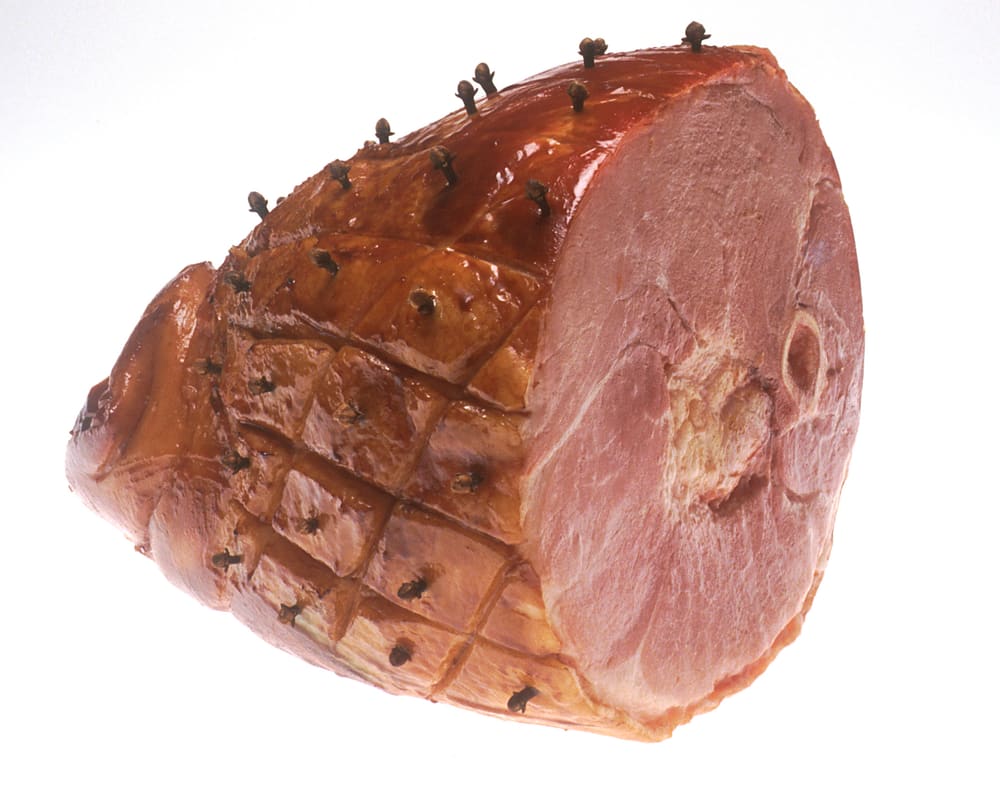
Photo: Renee Comet, National Cancer Institute (public domain), cropped.